
This is a follow up post to my popular article 20 Common Spring Weeds in Ontario. There has been much interest out there for an expanded list of weeds. Following are 20 common summer weeds here in Ontario with photos, tips on how to identify them and how to control them. While there is plenty of overlap between spring, summer and fall weeds with some of them being present in all seasons, the following selections either bloom in summer or are more noticeable in summer.
1. Black Medick (Medicago lupulina)
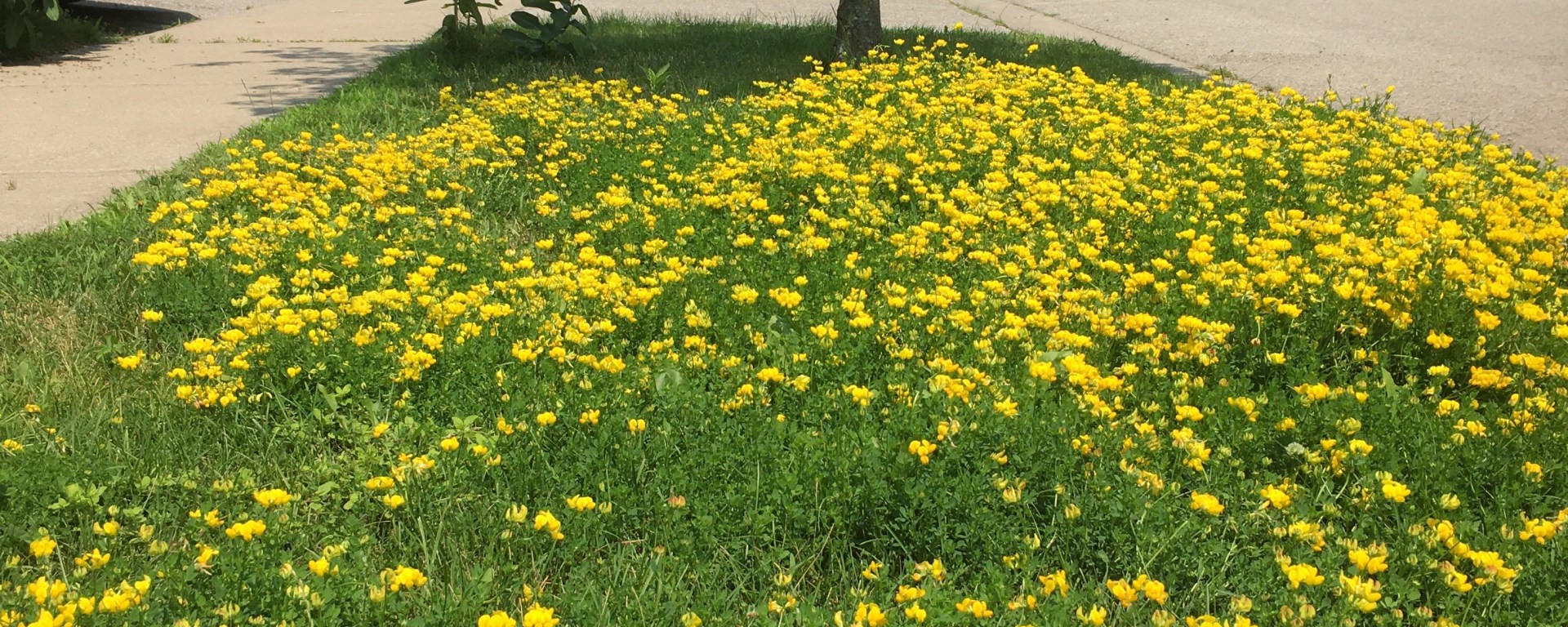
Black medick (Medicago lupulina), is a summer annual weed from the legume family (Leguminosae). As a member of the legume family, it is able to fix nitrogen in the soil. The plants typically grow prostrate but may grow more upright with support. The flowers are bright yellow and start off looking very much like clover flowers only slightly smaller but as the clusters of flowers begin to open each flower looks more like a pea flower with 5 petals, arranged with a broad top petal (called the “standard”), 2 two lower side petals (called “wings”) and two fused petals at the bottom (called the “keel”). The compound leaves have 3 leaflets (trifoliate) and look very similar to clover, but on black medick leaves the center leaflet is stalked and the bottom 2 unstalked while clover leaves have 3 unstalked leaflets all attaching directly to the stem. Black medick can form a large matt on the turf but does not root down at the nodes like clover. They form a branched taproot that may have nodules on it, caused by nitrogen fixing bacteria that convert atmospheric nitrogen to ammonia, (the form plants can take up). Black medick reproduces by seed which is formed in a cluster of single seeded pods that turn black when ripe.


Black Medick Control: In the gardens hand weeding, before it sets seed, is the best solution. Weeding when the soil is moist or loosening the soil around the root will make the pulling easier. Dispose of the weeds rather than leaving them on the soil. In the turf grass, black medick is usually a sign of compaction, low nitrogen levels, overly dry soil, and poor mowing practices all of which cause thin turf. Correcting these problems will help to get rid of this weed. Have the lawn aerated, reduce foot traffic (especially when wet), water regularly, fertilize regularly, mow higher and more frequently (removing only 1/3 of the height of the grass blade per mow). Spraying on the iron based selective broadleaf weed killer Fiesta® may help to control Black Medic. For interlock and cracks in driveways spot spraying young weeds on a sunny day with full strength cleaning vinegar (Acetic acid) or Fiesta® may help to top kill black medic.
2. Dog-strangling Vine aka Swallowwort (Vincetoxicum spp)
Dog-strangling vines are vigorous perennial vines in the sub-family of milkweeds (Asclepiadoideae) which is part of the Dogbane family (Apocynaceae). They are native to Europe and Asia. Here in Ontario, south/eastern Canada and north/eastern USA we have 2 highly invasive species of Dog -strangling vine, Pale Swallowwort (Vincetoxicum rossicum) and Black Dog -strangling vine aka Black Swallowwort (Vincetoxicum nigrum). Both of which are on the invasive species list. The vines can grow 2 m (80”) or more per season and have the habit of climbing and twining themselves around anything nearby such as shrubs, hedges, garden plants, taller grasses, fences and even each other. When their populations are high, they can completely overwhelm and kill desirable garden plants or in the wild they can kill off native plants. The leaves are ovate, 5-13cm (2-5″) long by about 1/2 as wide, dark green, a bit shiny, and arranged opposite one another up the stem. They resemble young milkweed leaves and monarch butterflies sometimes mistakenly lay their eggs on them. The leaves can be toxic to insects and wildlife. The stems are thin but strong and can get caught up in machinery and power tools. The flowers are fairly nondescript, located in small clusters in the leaf axils in summer from June-August. Individual flowers measure about 5-9mm are star shaped and consist of 5 petals. Pale Swallowwort has pinkish or maroon coloured flowers while Black Swallowwort has deep purple flowers that have hairs on the inner surface of the petals and wider petals. Bean-like seed pods that measure about 4-6 cm form after flowering, each filled with flat brown seeds that are covered in white hairs, that help them get air borne. The roots are fibrous and able to sprout from any pieces left in the soil. The roots like walnuts, are allopathic and release a chemical into the soil which can inhibit the growth of some plants. Note: there is a 3rd species here in North America that you may occasionally run across that has cream coloured flowers, White Swallowwort (Vincetoxicum hirundinaria), but its populations are not well established yet.


Dog-strangling Vine Control: In the garden young seedlings can be easily dug out and disposed of. Mature plants are more challenging to remove and require a shovel and deeper digging to remove all of the root. Any root fragments left behind can resprout. Dispose of plants in black garbage bags, do not compost. If you are unable to dig them out at the very least remove the seed pods and do not let them set seed. A promising biological control is the moth species Hypena opulenta. This moth is native to Ukraine where its caterpillar larvae feed on dog-strangle vine leaves. In 2014 researchers in Toronto and Ottawa released this moth species and have been carefully monitoring the results. In the turf grass they are not controlled by mowing and the vine can get tangled in equipment. Dig up the root crown and sprinkle some grass seed to fill the open soil. In hardscape areas such as interlock you can attempt hand pulling young plants when soil is moist, but it is hard to get all the root out. Keeping it cut back to the ground will prevent flowering and seed production but will not eliminate the weed itself.
3. Heal-all (Prunella sp.)
Heal-alls are perennial broadleaf weeds from the mint family. As members of the mint family (Lamiaceae), they have leaves that appear opposite one another on square stems that are able to root down at the nodes. This coupled with their creeping growth habit and fibrous root system, make them potentially aggressive weeds, especially in moist lawns. Flowers are purplish in colour and have a hood shaped upper lip and a 3-lobed lower lip that has a fringed center lobe that is often whitish in colour. We have 2 species here in Ontario, Prunella vulgaris ssp. vulgaris and Prunella vulgaris ssp. lanceolata.
- Prunella vulgaris ssp. vulgaris known as common self-heal, is native to Europe but has naturalized across much of North America. The leaves of this species are slightly larger, oblong in shape with stiff hairs on the upper leaf surface. This species tends to hug the ground more than P. lanceolata.
- Prunella vulgaris ssp. lanceolata known as lance self-heal is a native here in Ontario. The leaves of this species are more lance shaped and hairless or have soft hairs on the upper leaf surface. This species tends to grow a bit taller than Prunella vulgaris ssp. vulgaris.
All parts of this plant are edible, especially the leaves, which have a lemon flavour and are used raw in salads or cooked like spinach, which reduces the tartness. Medicinally the plant has been used as an astringent to treat wounds, as an anti-inflammatory, as a bactericide in the treatment of throat infections, and to expel parasitic worms.


Heal-all Control: plants are shallow rooted and quite easy to dig up in the garden. In the turf grass however, they can be quite challenging to remove as they tend to form dense colonies that require the complete removal of the affected turf and reseeding the area or resodding it. Prevention strategies include regular fertilizing (as heal-all occurs more in nutrient deficient soil), aerating the turf to reduce compaction and improve water and nutrient storage, de-thatching (scarification) the turf to improve water and nutrient storage. Reducing foot traffic which helps the plants to root down at the nodes. Over seeding the turf to keep it thick helps to prevent weed seeds from germinating. Regular mowing, removing only a 1/3 of the grass blade with each mow, is least damaging to the turf and will help to grow a healthier, thicker lawn. Spraying young heal-all weeds with the iron based selective broadleaf weed killer Fiesta® may help to top kill this weed. In interlock and other hardscape areas spot spraying young weeds with cleaning vinegar or Fiesta® on a sunny day may top kill them.
4. Wild Grapes Vines (Vitis spp.)
Wild grape vines (Vitis spp.) are perennial woody vines that can grow up to 15 m (50′). They are larger and more vigorous than the cultivated grapes and their dark purple fruits are smaller (each grape about 3mm in diameter). Like the cultivated grapes they are edible and an important food source for many birds and small mammals. In the wild they can overpower trees and other plant material they use to climb. In the home garden they can get quite weedy climbing fences, trees, shrubs and structures around the garden. The leaves are quite large up to 20cm (8″) long, heart shaped, usually with 3 shallow lobes, toothed margins and alternate up the stems. Young stems are green and pliable with tendrils (often forked) branching off opposite the leaves. As they age, they lignify (become rigid and woody) and have a shredded appearance. Flowers are white and fragrant and occur in early summer. Fruits are roundish berries that grow in tight clusters. They start off green maturing to dark purple. Seeds are pear shaped. Plants reproduce by seed often spread about by the birds and can root down at the nodes. Roots are woody tap roots with some fibrous lateral branching off the roots.

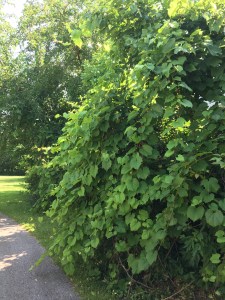

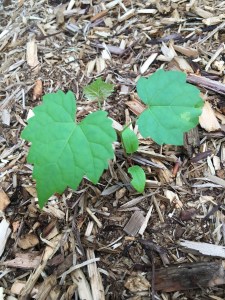

Wild Grape Control: In the garden young seedling are quite easy to weed out, but mature vines can be challenging to remove. If you are able to dig out the stump this is the best way to remove the plant but often the stump, in a home garden, is growing in an inaccessible spot like between back-to-back fences or under a shrub or low branching tree. In the latter case cut all the vines as close to the ground as you can. They will continue resprouting so you will have to regularly recut them until they eventually die out. Shutting the light out to the plant will also help to kill it as they demand bright sun to survive. Burn, shred or black bag the plant debris to avoid new plants sprouting from the debris. Wild grape vines are not usually a problem in turf grass or interlock.
Caution: If you plan on eating wild grapes it is important that you can properly identify this plant as there are a couple of look-a-likes that are poisonous, namely Virginia creeper and Moonseed. Virginia creeper leaves are compound with 5-leaflets rather than simple (not divided into leaflets) and its fruits are borne on reddish stems and not tightly clustered like grapes. Moonseed leaves have smooth leaf margins rather than toothed and the petiole attaches to the leaf slightly in from the leaf edge rather than at the leaf edge like grape leaves. The leaf tips of moonseed are also sharply pointed. Moonseed have flattened seeds in a crescent shape rather than plump and pear shaped like grape and moonseed vines do not have tendrils.
5. Common Chicory (Cichorium intybus)
Common chicory is an edible perennial species from the Asteraceae family and closely related to the dandelion. Like dandelions they form a basal rosette of coarsely toothed to lobed, lanceolate leaves that can grow up to 25cm (10″) in length. Both bleed a milky latex sap when cut. The teeth along the leaf margins of both plants can be quite variable but on chicory they tend to be shallower and more saw-like, pointed up and may not mirror the other side of the leaf, as they do in dandelions. Chicory leaves also tend to be hairy. In summer the plant sends up a sturdy, well branched stem that is hairy towards the base and can grow up 150cm (5′) tall. The composite flowers are typically blue, but occasionally white or pink, each blooming for less than one day from July through August. The flowers are comprised of about 17 ray florets which look like petals with teeth along the outer edge, but they actually consist of 5 petals fused together, each with its own anther and style. Chicory forms fleshy, edible taproots that can measure about 23 cm (9″) in length. Plants reproduce by seed and bits of root fragments. One plant can produce as many as 3000 seeds per plant. The seeds are heavier than dandelion and typically do not travel on the wind as far but birds like gold finches can spread them in their droppings.


Chicory Control: in the garden beds young plants are easy to dig up but once they mature you will need the shovel to dig out the taproots. In turf grass they are NOT controlled by mowing and plants will regrow and flower below the blade height. A dandelion prong may help weed out younger plants.
6. Field Bindweed (Convolvulus arvensis)
Field bindweed is a perennial vine from the Morning-glory family (Convolvulaceae). They can grow to about 150cm (5′) either prostrate along the ground in turf grass or climb up garden plants by twining themselves around the stems. They develop both deep tap roots and extensive lateral roots and are able to sprout from root fragments left in the soil, making them very difficult to control once establish. The trumpet shaped flowers appear in summer July through August and look similar to morning glory flowers. They are either white or pink measuring about 2.5-5cm (1-2″). The leaves are arrowhead shaped, with smooth margins, hairy to hairless, and alternate up the vine, each leaf measuring up to (5cm) 2″ in length. Seed pods are egg shaped and contain 4 dark brown seeds measuring about 1/8″ long that can remain viable in the soil for years. This weed can be particularly troublesome on bare soils.


Hedge bindweed (Calystegia sepium) looks a lot alike, but its leaves and flowers are 2-3 times bigger. Its flowers are only white and the 2 leafy bracts that are located about 1″ below each flower on field bindweed are located instead at the base of each flower where they fold up enclosing the base of the flower. Hedge bindweed has a shallower root system and tends to be found more in uncultivated areas.
Bindweed Control: In the garden, manual removal of this weed once it has established its extensive root system, involves relentless pulling every 2 weeks for about 2 years (maybe more) until you have depleted the roots food reserves. Laying down landscape cloth with a mulch on top will stop the existing seeds in the soil from germinating and shut off light to the existing plants, but they are masters at finding the light and tend to pop up at the base of plants where the cloth has been cut. In the turf grass young plants may be controlled by mowing but established plants are not controlled by mowing. Putting the grass catcher on the lawn mower and black bagging the clippings will help to stop spreading the fragments around the yard where they can root down and make new plants. In interlock and other hardscape areas you can attempt hand pulling young plants when soil is moist, but it is hard to get all the root out. Keeping it cut back to the ground will prevent flowering and seed production but will not eliminate the weed itself.
7. Wood Sorrel (Oxalis spp.)
Wood sorrel are perennial species in the bean family (Leguminosae). There are hundreds of species. The most common here in Ontario are Oxalis corniculata (creeping wood sorrel), Oxalis dillenii (Common yellow wood-sorrel), Oxalis stricta (European wood-sorrel) and Oxalis montana (mountain sorrel). The first 3 species have small yellow, 5 petaled flowers that measure about 1/3 of an inch, the 4th species (Oxalis montana) has whitish to purplish flowers that may or may not have purplish venation on the petals with slightly bigger flowers about 2.5 cm (1″). The leaves of Oxalis are trifoliate (have 3 leaflets), heart shaped with a fold down the middle and fold closed at night. They are often mistaken for clover.

Oxalis plant size varies with creeping wood sorrel growing short and more prostrate, rooting at the nodes while common yellow wood-sorrel plants grow to about 20cm (8″) in height, rarely rooting at nodes. European wood-sorrel can grow taller, up to 50cm (20″) and mountain sorrel is stemless and grows in short clumps that expand by rhizomes or stolons. Wood sorrel have bean-like seed pods that forcibly eject their seeds when touched. Plants spread by seeds, rhizomes and stolons.

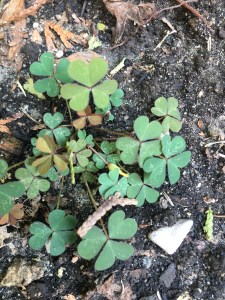
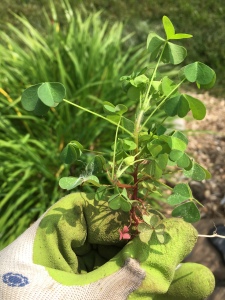

Wood Sorrel Control: can be dug out from garden beds being careful to remove all the root. Root fragments that remain in the soil can resprout. They are more challenging to remove from lawns, especially creeping wood sorrel. Establishing a thick healthy lawn is your best defense against this weed. In interlocking brick, they often break when pulling, loosening the soil around the root with a knife can help in their removal. Cleaning vinegar (Acidic acid) sprayed on wood sorrel plants in sidewalks and driveways, especially on a sunny day, may top kill this weed.
8. Nightshade Weeds (Solanum Spp.)
3 common weedy nightshades that we have here in Ontario are Climbing nightshade (Solanum dulcamara), Eastern black nightshade (Solanum ptycanthum), and Hairy nightshade (Solanum sarrachoides). All 3 are poisonous.
- Climbing nightshade (Solanum dulcamara) commonly called bittersweet nightshade, is a highly invasive perennial vine that grows to about 2m but can reach up to 4m. They can climb using other plants for support or trail along the ground. They have purplish star shaped flowers in summer (June-July) with 5 petals that are followed by clusters of bright red berries. Youngest leaves are oval to ovate with pointed tips and are hairy with smooth margins, while more mature leaves often have basal lobes and measure about 2 to 5 inches long, often with a purplish tinge and emit a foul odour when crushed. Leaves alternate up the stems which are woody at the base, hollow, slightly hairy, and mature in colour from purplish to green then greenish-brown then finally woody. Vines are able to root down at the nodes.
- Eastern black nightshade (Solanum ptycanthum) is an annual weed (occasionally a short-lived perennial), that grows as a multibranch plant up to 90cm (3′) tall. This plant commonly occurs here in Ontario while in the western part of the country Black nightshade (Solanum nigrum) is more common. The flowers on this species are white and star shaped with 5 petals which mature to black glossy berries. The pale green leaves alternate up the stems and are quite thin and somewhat translucent. The leaf shape can vary a bit but typically are oval to diamond shaped with irregularly toothed margins.
- Hairy nightshade (Solanum sarrachoides) is an annual weed, (occasionally a short-lived perennial), that grows as a multibranch plant up to 60cm (24″) tall. The flowers on this species are white and star shaped with 5 petals which mature to yellowish brown to brown berries. As the name suggests the stems and leaves are quite hairy and covered in soft gland-tipped hairs. When cut the stem emits a strong sweet aroma. Leaves are dull green to grey-green, thick, hairy and somewhat sticky. The leaf shape can vary from ovate to somewhat triangular with wavy to bluntly toothed margins. Note: There is a lot of controversy about the scientific name of this plant, it is sometimes referred to as Solanum physalifolium or S. physalifolium var. nitidibaccatum or the 3 are considered 3 distinct species.

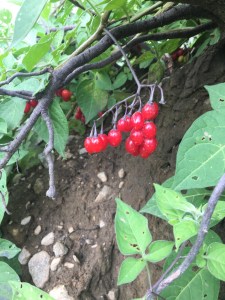


Controlling Nightshade Weeds: In the gardens they can be dug out, being careful to remove the tap root so the plant cannot resprout. This will be more challenging for the perennial species, especially once they are mature, it may take several attempts. Annual species can be controlled by preventing the plants from flowering and setting seed. Adding a heavy layer of mulch will also help keep the seeds (the birds poop out) from germinating in your garden. For larger patches solarization or occultation may be more practical. Solarization involves placing heavy clear plastic over the affected area for 2-3 weeks during the summer while occultation involves using heavy black plastic to cover the affected area for about 6 weeks. In the turf grass repeated hand pulling or digging out the tap root especially before seed production. In hardscape areas repeated hand pulling or cutting off with hand pruner and black bagging the clipping.
9. Spotted Spurge (Euphorbia maculata), Prostrate Spurge (Euphorbia prostrata), and (Euphorbia humistrata)
These 3 summer annual species in the spurge family (Euphorbiaceae) and are very difficult to tell apart. Spotted spurge, as the name suggests has leaves that often have a reddish spot, or blotch in the center of their dark green leaves. These plants grow in a low, highly branched matt that can grow up to 90cm (3′) in diameter. The leaves are arranged opposite each other on pink to reddish hairy stems that DO NOT root down at the nodes like the 2 very similar species Euphorbia humistrata and Euphorbia prostrata. When broken the stems bleed a white milky substance that can irritate your skin and eyes. The roots are well branched with deep tap roots (up to 60cm or 2′ deep), that can resprout from fragments left in the soil. Flowers are nondescript tiny little pinkish to pale green clusters tucked into the leaf axils near the outer branches. Flowers in the summer June through to October. Flowers quickly give way to an abundance of sticky seeds that can quickly germinate or remain in the soil, sprouting when conditions are right, for years to come.
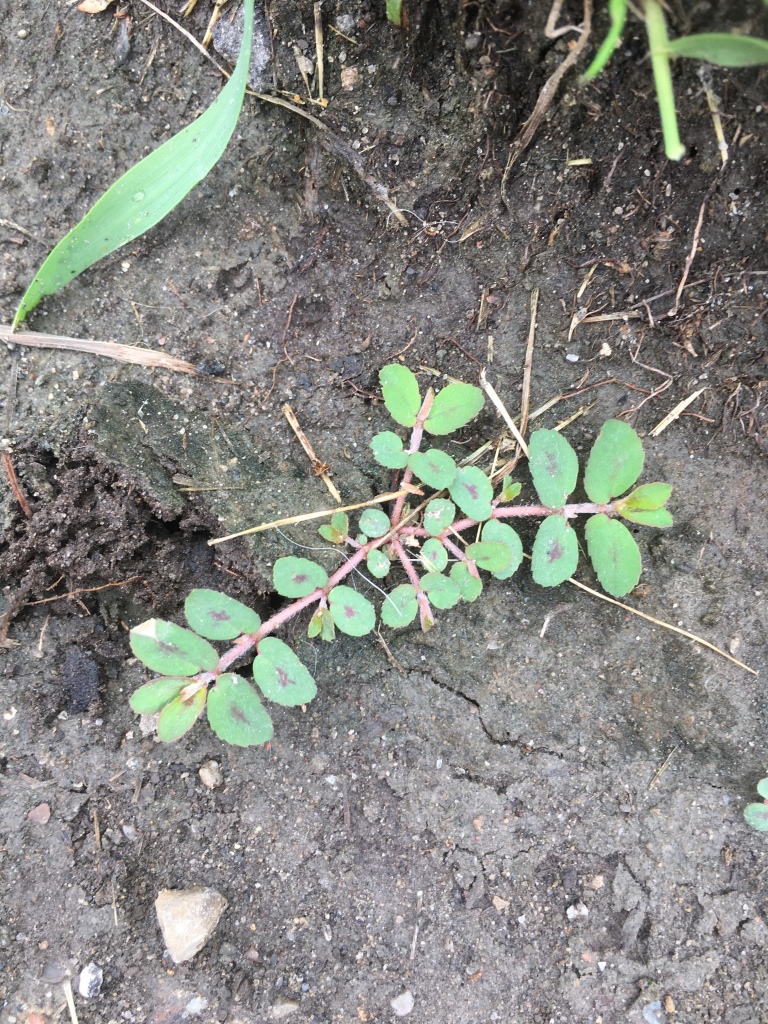


Control of Spurge weeds: These annual weeds have almost no seed dormancy requirements and are able to produce seed in about month after germinating. This means you need to stay on top of this weed, removing it every couple of weeks. In the garden beds they can be dug out carefully, making sure to get all of the root as they can regenerate from fragments left in the soil. This makes them more difficult to remove from turf, but constant pulling will prevent new seed production and gradually starve the roots. Keeping your turf well-watered, fertilized and properly mowed will help prevent this weed from establishing in your turf. In interlock and other hardscape areas cleaning vinegar (Acidic acid) sprayed on the weeds on a sunny day may top kill them. DO NOT cut these weeds down with the lawn trimmer and blow the cuttings as you will just spread this weed to your turf or other hardscape areas.
10. Queen Anne’s Lace (Daucus carota)
Queen Anne’s Lace (Daucus carota) aka Wild Carrot is a biennial weed in the carrot family (Apiaceae). In their first year of life, they form a basal rosette of finely divided fern-like, tri-pinnate leaves that look and smell (when crushed) like carrots. They form a tap root that is edible when young but becomes increasing woody as the plant matures. In the second year of life the plant sends up a long, hollow, branched, hairy stem that can grow up to 120cm (4′) tall. Large, white, lacy looking flat toped flower umbels form at the ends of these branches measuring about 5-10cm (2-4″) in diameter. In the center of each compound umbel there is often a single purple flower. When the flowers have finished blooming, they fold themselves up, turn brown and look like small bird’s nests. The plants are in bloom all summer long but are most noticeable in late summer. The seed produced in these nests are covered in barbs that can easily stick to clothing and animal’s fur. After the plant has produced its seed, it dies.


Queen Anne’s Lace control in garden beds involves hand pulling young plants. Dig out the rosettes or regularly till them into the soil. If the plants are growing in an area that cannot be dug, cut the stems near the soil line in July to prevent them from flowering and setting seed. Queen Anne’s Lace is not usually a problem in turf grass or hardscape areas.
11. Bull Thistle (Cirsium vulgare)
Bull Thistle (Cirsium vulgare) aka. spear thistle is a biennial weed in the Aster family (Compositae). Seeds germinate in the spring and form a rosette of at first oval, dark green leaves that have wavy-toothed and spiny margins with soft fuzzy hairs on the underside. Leaves elongate as they mature up to 18cm (7″) and become deeply divided and develop sharp prickly hairs on the upper leaf surface and sharp prickles along the margins. This is not a plant you want to run into walking barefoot through the lawn. In the second year the plant sends up a well branched hairy and spiny stem that’s about 1-1.5 m (3-5′) tall. Flowers are deep pink to purple with spiny round to pear shaped bases measuring about 4cm (1.5″) in height. Plants bloom in summer July through August. Seed dispersal is assisted by the presence of pappus (a dandelion like fuzz attached to seeds), that helps to carry them farther away on the wind. Plants form a tap root in the first year and adds some smaller lateral roots in the second year. The plant dies after it has set seed.
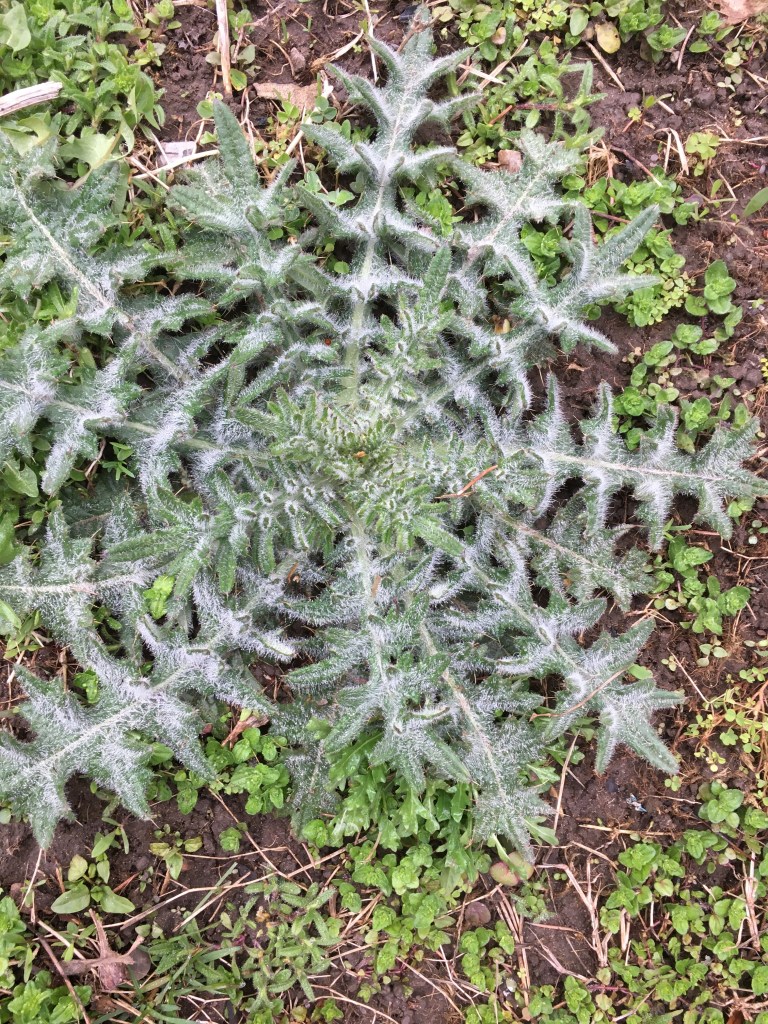

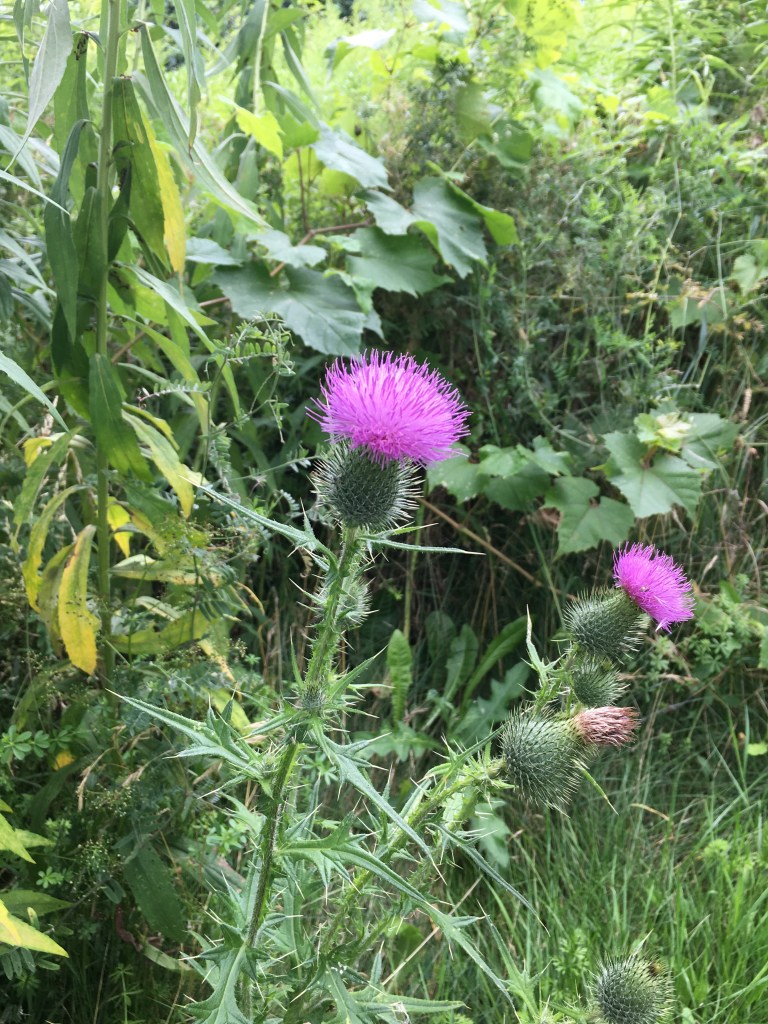

Bull Thistle Control: in the garden beds is best accomplished by digging out the rosettes and trying to get as much of the tap root as possible. In the turf grass digging them out also works well. Mowing will help to control this weed by preventing flowering, but the prickly plant largely remains below the mower blades for 2 years before it dies. Spraying on the iron based selective broadleaf weed killer Fiesta® may help to top kill this weed.
12. Spiny Annual Sow-thistle (Sonchus asper)
Spiny Annual Sow-thistle (Sonchus asper) is an annual weed (occasionally a biennial) in the aster family (Compositae). As the name suggests the leaves have prickly margins. The seeds typically germinate in spring (although they can germinate anytime in the season). The plants produce a rosette of shiny, dark green leaves with a white center mid-rib, that can vary in shape but are typically lanceolate and taper to a pointed tip, measuring up to 25cm (10″) in length by about 1/3 the width. Margins are wavy toothed to deeply divided and spiny. Leaves attach to the stem by way of 2 large spiral auricles (this helps to differentiate it from annual sow-thistle, S. oleraceus, which has 2 small, pointed auricles). From the rosette a single, usually unbranched, non-hairy, hollow stem grows up to 1.5m (5′) tall. Plants bleed a milky fluid when cut that can irritate skin and eyes. Yellow dandelion-like ray flowers are borne at the ends of the branches in summer June through August. Seed dispersal is assisted by the presence of pappus (a dandelion-like fuzz attached to seeds), that helps to carry them farther away on the wind. The plants then die before winter.


There are a few closely related species that look alike, perennial sow-thistle (Sonchus arvensis), smooth sow-thistle (Sonchus arvensis var. glabrescens) and annual sow-thistle (Sonchus oleraceus). These 3 species are not prickly only spiny.

Spiny Annual Sow-thistle control involves digging them out of garden beds as their hollow stems break quite easily when pulled. Dig deep enough to get all the tap root if possible. In the lawn dig them out or repeatedly snip them off at soil level. Mowing helps to control this weed by keeping them from flowering. If you have a lot of this weed in your turf keep it regularly mowed to about 20cm (8″) in height. In sidewalks and driveways repeatedly snip them off, the lawn trimmer works well for this.
13. Curled Dock (Rumex crispus)
Curled Dock (Rumex crispus) is an invasive perennial weed in the smartweed family (Polygonaceae). Plants are capable of producing up to 40,000 (Cornell University, (n.d.)) to 60,000 (Michigan State University, (n.d.)) seeds per plant. Seeds germinate spring through fall producing a rosette of elongated leaves (oblong-lanceolate) with pointed tips, that have curled or wavy margins, the characteristic for which the plant is named. Leaves are hairless and highly textured with prominent veins measuring up to 30cm (1′) in length. They are green in colour, often developing a reddish tinge as the season progresses. The plants send up an erect sturdy ribbed stem which is hairless, and mostly unbranched until the top where the flower clusters form. Young plants send up only one stem, but mature plants can send up multiple stems. A distinguishing feature is the ocrea (a papery sheath) that wraps around the area where the leaf stems attach to the plants stem. Long, dense green branching clusters of flowers form towards the top of the stems which change from green to reddish brown. Plants bloom in summer June through to September. Flowers give way to seed formation consisting of triangular shaped achene that are brown in colour. Plants produce a long yellowish taproot that can reach a depth of up to 150cm (5′) in ideal soils.

Curled Dock Control in the garden beds can be achieved by digging up the plants and their tap root. If this is not possible cutting the plant down to about 5cm (2″) below the soil line is said to control curly dock (Michigan State University, (n.d.)). Tilling and burying the pieces of tap root will also help control this weed but is only practical in annual garden beds. In the turf, cut the plants down 5cm (2″) below the soil line or just mow to prevent seed formation. In interlock and other hardscape areas repeatedly cutting this weed back will eventually deplete the tap root of food reserves, a grass trimmer works well for this.
14. Common Milkweed (Asclepias syriaca)
Common Milkweed (Asclepias syriaca) is a native perennial in the Dogbane family (Apocynaceae). They owe their weedy nature to the extensive root systems they produce, consisting of a long tap root and an extensive network of rhizomes that can send up new shoots from adventitious buds located along these horizontal roots. Plants also reproduce by large windblown seeds that are assisted in their flight by coma (white silky hairs that catch on the wind). Seeds typically germinate in the spring after last frost. Plants send up a strong, hollow unbranched, hairy stem about 1-1.5m (roughly 3-5′) tall. Large, oblong shaped, dark green waxy leaves that are smooth on the top and hairy on the bottom appear opposite one another up the stem. Leaves have a white mid-rib and measure up to 20cm (8″) long by half as wide. Both stems and leaves bleed a white milky sap when broken that can irritate skin. 1-3 large, highly fragrant pink to purple, 5-petaled flowers appear in large clusters (umbels) arising from the leaf axils higher up on the plants. Plants flower in summer June through August. The flowers give way to large 5-10cm (2-4″) warty seed pods.
There are many other species of milkweed, several which are also native to Ontario such as Swamp Milkweed (Asclepias incarnata), Butterfly Milkweed (Asclepias tuberosa), Purple Milkweed (Asclepias purpurascens), Poke Milkweed (Asclepias exaltata) and Whorled Milkweed (Asclepias verticillata). All are essential for the life cycle of the monarch butterflies’ larvae who only feed on milkweed.

Milk Weed Control in the garden beds involves digging them up and removing them from the site or cutting them off repeatedly at the soil line. This will be an ongoing process until you have exhausted the carbohydrates stored in the roots. In the turf grass keeping it regularly mowed will gradually weaken and deplete the root system.
15. Prostrate knotweed (Polygonum aviculare)
Prostrate knotweed (Polygonum aviculare) is a summer annual weed in the Smartweed family (Polygonaceae). As the name suggests this weed grows prostrate in highly branched matts that can grow over 90cm (3′) in diameter. The stems of this plant are thin, strong and wiry, with alternating leaves that are joined to the stem by an ocrea (a papery sheath). Each leaf node is swollen creating the appearance of knots running down the length of the stems. Leaves are narrow, lance-shaped to oblong with a pointed tip and a glossy green to blue/green colour. Inconspicuous white or pink Flowers form in the leaf axils from June-September, which give way to prolific seed production. These seeds require a chilling period and remain dormant in the soil until very early spring. Roots consist of a long narrow tap root. The roots and stems of prostrate knotweed are allelopathic and inhibit the growth of surrounding plants, including grass. This weed is often confused with spotted spurge and prostrate spurge which form a similar highly branched matt, but spurge plants bleed a milky fluid when broken and the leaves are more oval rather than lance shaped.
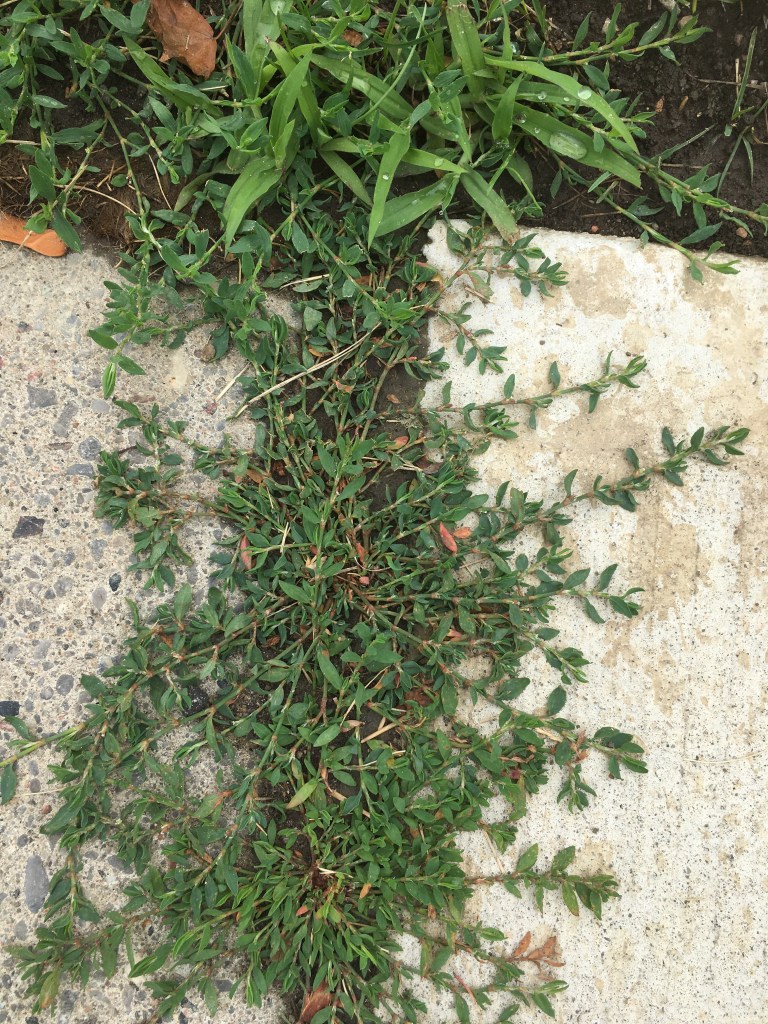
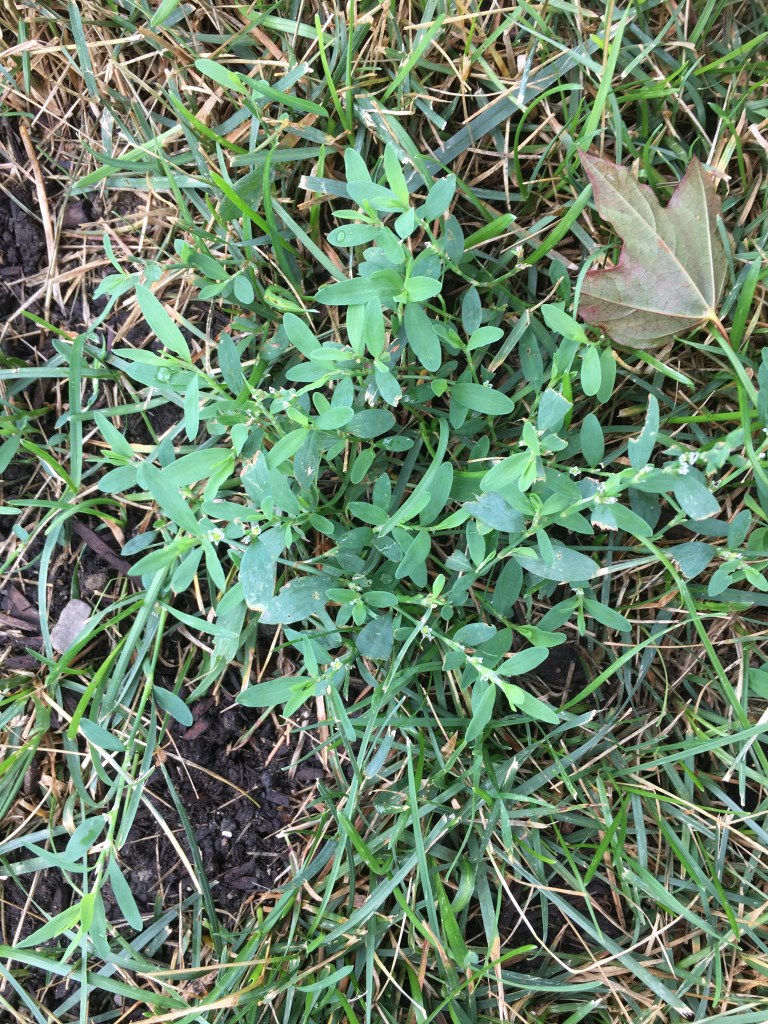
Prostrate Knotweed Control begins with modifying site conditions that encourage this weed to grow such as soil compaction, soil infertility and poor drainage. Dig the garden beds well breaking up any compaction and add plenty of organic matter to improve the soils’ structure and fertilize regularly. Mulching garden beds will also help to reduce seed germination of this weed. Hand pull weeds or dig them out. Aerate turf grass and fertilize regularly. In small numbers hand pulling in moist soil works well. Mowing does not control this weed and can actually make the problem worse by spreading the seed. In interlock and other hardscape areas hand pull when soil is moist.
16. The Common Mullein (Verbascum thapsus)
Common Mullein (Verbascum thapsus) aka The Great Mullein is a biennial species in the figwort family (Scrophulariaceae). This tall and stately plant is more likely to appear in home acreages and such, but it also can appear in city landscapes. The leaves form a basal rosette of long bluish silver-green oblong leaves that feel soft and fuzzy to the touch. In the second year of life the plant sends up a very long (1-2 m) fuzzy and winged stem with alternating leaves. The stem terminates in a long-elongated flower spike with many bright yellow, five petaled flowers that do not all bloom at once but rather typically begin blooming at the bottom gradually working their way up the flower stalk. This flower stalk can range between 20-50cm (9-20″) in height and is usually single but it may also branch out at the top. Plants bloom in summer June through August. Flowers give way to prolific seed production. One plant can produce between 100,000‑240,000 seeds per plant (Mahr S., (n.d.)). These seeds require light in order to germinate but can remain dormant in the soil for decades until a soil disturbance brings them to the surface. Roots consist of a shallow tap root with some secondary fibrous roots.


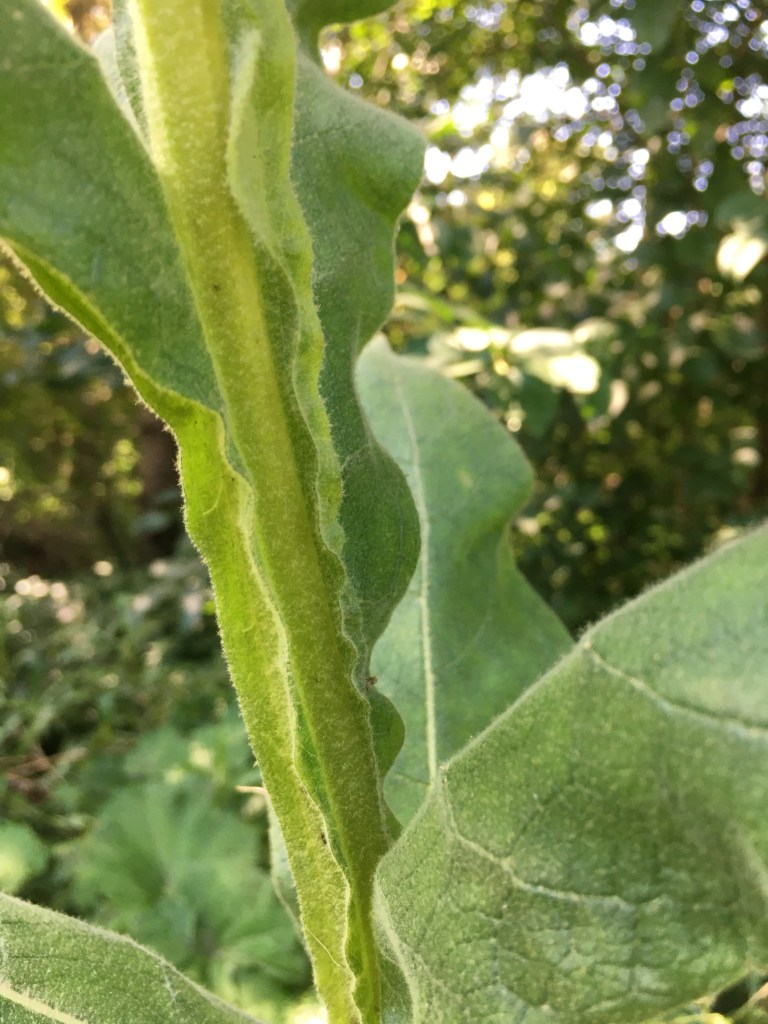

Common Mullein Control in the garden begins with removing the plants before they can set seed. Due to their somewhat shallow root plants are usually easily pulled or dug. Mulching garden beds and avoiding soil disturbance will help to prevent further plants from germinating. In the turf grass mowing is not effective control as the rosette persists and the flowering stem can bolt between mows. Carefully spot spraying with glyphosate-based products like roundup® may be effective at controlling this weed. In interlock and other hardscape areas this weed is not usually a problem.
17. Tufted Vetch (Vicia cracca)
There are many species of vetch worldwide, some annuals – such as hairy vetch (Vicia villosa) and some native to Ontario – such as marsh vetchling (Lathyrus palustris), tuberous vetchling (Lathyrus tuberosus) and pale vetchling (Lathyrus ochroleucus). Tufted vetch however is a non-native perennial weed that has become highly invasive in southern Ontario. Other common names include cow vetch, bird vetch and blue vetch. It has a sprawling habit with the ability to climb nearby plants. The plants send up a long, weak, multi-branched stem that can reach up to 2m (80in) in length. The stems are square with ribs running down its length and covered in short appressed tufts of hairs (meaning the hairs tend to lay down flat against the stem rather than stick straight out). From this stem pinnately compound leaves alternate up the stem, with fairly long internodes between leaves. Each compound leaf consists of up to12 pairs of medium green elliptically shaped leaflets that are covered in short appressed hairs giving the leaflets a slightly greyish cast. Each compound leaf terminates with a pair of tendrils that can wrap themselves around nearby plants, thus helping them to climb. Another distinguishing feature is the presence of short, narrow stipules (leafy appendages), that are pointed and covered in short hairs, especially around the margins. These stipules are located at the base of each leaf stalk. Purplish coloured flowers appear in abundance in the upper portion of the plants from late spring through to late summer. The pea-like flowers hang down and are arranged in groups of 30 or more up one side of the flower stalks only. The flowers give way to brownish coloured seed pods that darken as they mature. The roots consist of both a deep tap root and rhizomes. As a member of the bean family (Leguminosae) tufted vetch, like other vetches, are able to fix nitrogen in the soil by forming a symbiotic relationship with certain soil inhabiting bacteria called rhizobia. This gives the plant the ability to thrive even in poor or neglected sites.


Management and Control: In the home garden pull or cut this weed off at ground level, preferably before flowering. The stem will likely reemerge the following year but just keep pulling or cutting until the food stored in the roots is used up. To prevent new introductions of this weed to your yard use certified weed free products only, do not move soil around or introduce any soil to your yard that contains viable traces of the rhizome. In turf grass mowing this weed works as above but do not mow if the weed has formed seeds, hand pull those instead and dispose of them.
Another highly invasive vetch species in Ontario is Crown Vetch (Coronilla varia). This species is much shorter growing only to about 30cm (1′) in height (sometimes taller) by about a 60cm (2′) spread. It usually has This one can be quite challenging in turf grass as it can flower below the lawn mower blades.

18. Common groundsel (Senecio vulgaris)
Common groundsel (Senecio vulgaris) is an annual species from the aster family (Asteraceae). It owes its weediness to the prolific number of airborne seeds it produces, and the plants’ ability to rapidly complete its lifecycle and produce about 3 generations in a single season. Thankfully the seeds do not remain viable in the soil for long, usually about 1 year. Mature seeds do not require a dormancy period (Smith-Fiola D., and Gill S. (Updated: January 21, 2022)) but prefer the cooler weather of spring and fall or a shady sight in summer, in order to germinate. They also require light to germinate. Similar to dandelions, common groundsel seeds are wind dispersed with the aid of some white fluff called pappus attached to one end of the seed. Once germinated the seedlings form a small rosette of dark green, somewhat fleshy leaves. Young leaves start off somewhat rounded to oval with small teeth around the margins but become more elongated and deeply lobed as they mature, measuring about 5-10 cm (2-4″). Basal leaves have a petiole, but upper leaves do not, rather they clasp directly to the stem by means of small lobes at their base. Once mature the plant sends up 1 well branched upright, hollow stem measuring 10-40 cm tall (4-16″) tall with alternate leaves. These stems may root at nodes that touch the ground. Yellow disk flowers form in clusters at the ends of branches and stem. They look similar to unopen dandelion flowers. These rayless flowers are surrounded by green bracts each of which has a distinguishing black dot at the tip. Flowers begin appearing 5-6 weeks after germination. The roots consist of shallow fibrous roots and a very short tap root that can be hard to distinguish.


Management and Control: In the home garden this shallow rooted weed is easily managed by hand weeding before the plants flower. If the plant is already in flower, it must be removed from the garden and not left lying on the soil as it is still able to set seed after pulling. If you have pets, it is important to know that this plant is poisonous to dogs and cats (ASPCA, (n.d.)). This weed is particularly problematic for nurseries, so be sure to check any potential plant purchases for this weed. Also buy only weed seed free soils, manures or composts. Mulching garden beds with a 75mm (about 3″) layer of organic mulch will help to prevent windblown seeds from germinating in your garden. In turf grass either hand pull or mow incredibly short as this plant can flower at only a few inches tall. In interlock and other hardscape areas hand pull in moist soil.
19. Lamb’s-quarters (Chenopodium album)
Lamb’s-quarters (Chenopodium album) is an edible, annual weed in the (Amaranthaceae family, sub-family Chenopodioideae). Note: Lamb’s quarters were previously part of the Goosefoot family (Chenopodiaceae), but this family has since become a sub-family of the Amaranthaceae family. According to the government of Ontario Lamb’s-quarters is “Considered one of the most competitive annual broadleaf weeds in Ontario (Government of Ontario, (2023)). It owes this reputation to their abundant seed production, many of which germinates earlier than most plants in spring, and to its rather large size, growing up to about 1-11/2 m (3-5′) in height. Lambs-quarters produce different types of seed on the same plant, each having its own germination requirements. Many of the seeds germinate in spring, after the period of cool damp weather and especially after tillage. Other seeds may germinate later but begin flowering in a shorter amount of time (in as little as 5-6 weeks). Typically, though they flower in summer (from July till September). Ungerminated seed can remain viable in the soil for many years. Lamb’s-quarters stems grow upright with typically many upward branches. The stem is hairless and develops reddish coloured ridges up its length. Mature plants appear triangular in shape. The first few leaves start off opposite but then begin alternating up the stems. They measure up to 10cm (4″) in length and are triangular to diamond in shape with irregular teeth around the margins. Leaves are covered in a white mealy powder, (which is actually salt deposits), it is especially noticeable on younger leaves. The underside of the leaves may have a pinkish tinge or whitish cast. Flowers are non-descript, consisting of tiny green flowers with 5 tepals and 5 stamen that are tightly clustered together into inflorescence spikes. The spikes arise out of nodes and at the tips of branches. The flowers give way to whitish green seed pods that can turn a purplish red colour as they mature. Roots consist of short, branched tap roots.
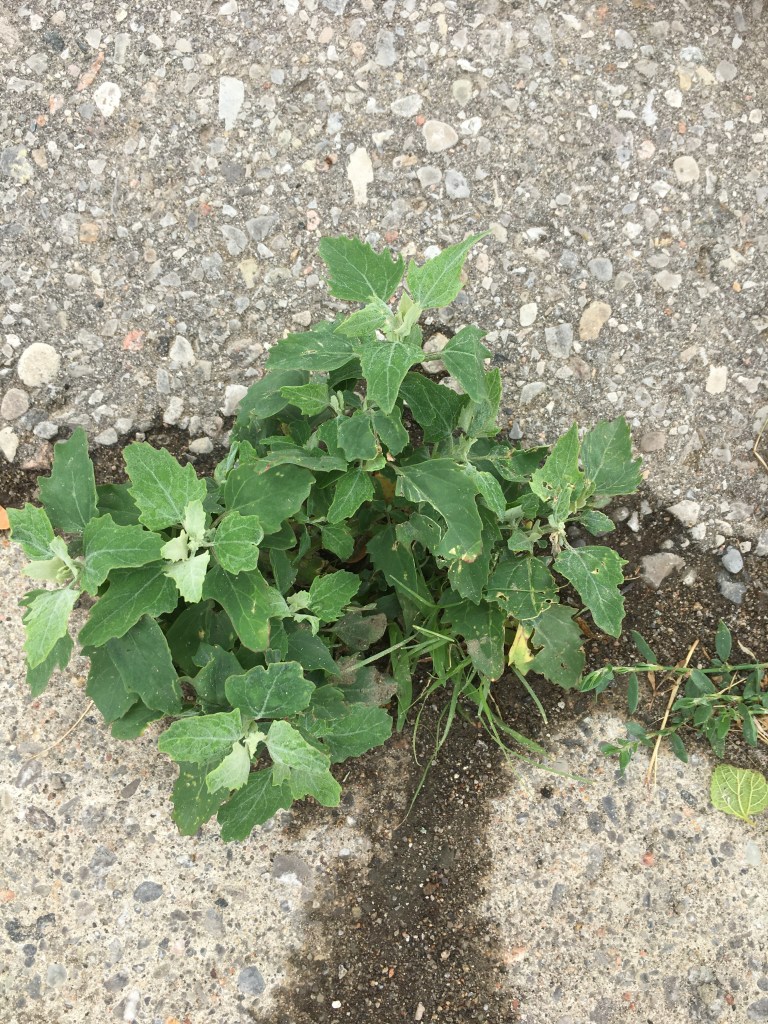
Lamb’s-quarters Management and Control: in the garden beds dig them out before they flower. If they are not in flower or seed, they may be composted, otherwise black bag them, as the flowers can still set seed even after the plant has been cut or removed. In regularly mowed turf grass, they are not typically a problem, as they do not fare well with regular mowing or foot traffic. In areas that are mowed infrequently they can be more problematic as they are able to flower at about 6″ in height if necessary. In interlock and other hardscape areas hand pull in moist soil, cut of regularly at ground level (a lawn trimmer works well for this).
20. Pineappleweed (Matricaria matricariodies)
Pineappleweed (Matricaria matricariodies) is an annual weed in the Aster Family (Compositae).


Photo credits: all photos by the author.
Updated March 16th, 2024
References:
Abbey T. (Updated: January 3, 2023). Bull Thistle Identification and Management. Penn State Extension. https://extension.psu.edu/bull-thistle-identification-and-management
Abbey T., (Updated: December 19, 2022. Prostrate knotweed. https://extension.psu.edu/prostrate-knotweed
Alsaadawi, I. S., & Rice, E. L. (1982). Allelopathic effects of Polygonum aviculare L. I. Vegetational patterning. Journal of chemical ecology, 8(7), 993–1009. https://doi.org/10.1007/BF00987881
Anderson, H. 2012. Invasive Dog-strangling Vine (Vincetoxicum rossicum) Best Management
Practices in Ontario. Ontario Invasive Plant Council, Peterborough, ON. https://www.ontarioinvasiveplants.ca/wp-content/uploads/2020/10/DSV_BMP.pdf
ASPCA, (American Society for the Prevention of Cruelty to Animals) (n.d). Groundsel. https://www.aspca.org/pet-care/animal-poison-control/toxic-and-non-toxic-plants/groundsel
Botanical online, (2021). How to Differentiate Chicory from Dandelion. https://www.botanical-online.com/en/medicinal-plants/differences-chicory-dandelion
Bakacsy, L., Bagi, I. Survival and regeneration ability of clonal common milkweed (Asclepias syriaca L.) after a single herbicide treatment in natural open sand grasslands. Sci Rep 10, 14222 (2020). https://doi.org/10.1038/s41598-020-71202-8
Bouchard C.J. and Neron R. (2003). Identification Guide to the weeds of Quebec. Publisher: Conseil des productions vegetales du Quebec inc. 2003
CABI, (2021). Rumex crispus (curled dock). https://www.cabidigitallibrary.org/doi/10.1079/cabicompendium.48059
Cookie Baby, Inc. (n.d.). Poisonous Plant Dangers Around The Home For Babies, Toddlers, and Children. https://maltawildplants.com/ASTR/Docs/SENVU/Common%20Groundsel%20-%20Poisonous%20Plant%20Information.htm
Cornell University, (n.d.) Curly dock. Cornell Weed Identification. https://blogs.cornell.edu/weedid/curly-dock-2/
Cornell CALS, (n.d.). Hedge bindweed. https://cals.cornell.edu/weed-science/weed-identification/bindweed-identification/hedge-bindweed
Cornell CALS, (n.d.). Field bindweed. https://cals.cornell.edu/weed-science/weed-identification/bindweed-identification/field-bindweed
Cornell University, (n.d.). Bull Thistle. Cornell Weed Identification. https://blogs.cornell.edu/weedid/bull-thistle/
Cornell CALS, (n.d.). Common Milkweed. https://cals.cornell.edu/weed-science/weed-profiles/common-milkweed
Cornell University’s College of Agriculture and Life Sciences, (n.d.). Common lambsquarters. https://cals.cornell.edu/weed-science/weed-profiles/common-lambsquarters
Cornell University’s College of Agriculture and Life Sciences, (n.d.). Common groundsel. https://cals.cornell.edu/weed-science/weed-profiles/common-groundsel
Crawford Conservation, (n.d.). Cut Your Grapevines!!!!. https://crawfordconservation.com/assets/pdf/Grapevines.pdf
Cowbrough M., OMAFRA, (2020). Dog Strangling Vine Control with Herbicides. http://omafra.gov.on.ca/english/crops/field/news/croptalk/2020/ct-1120a3.htm
Gassmann A., (2016). Vincetoxicum rossicum (European swallowwort). Cabi Digital Library. https://www.cabidigitallibrary.org/doi/10.1079/cabicompendium.55104
Gibson, D. M., Vaughan, R. H., & Milbrath, L. R. (2015). Invasive swallow-worts: an allelopathic role for -(-) antofine remains unclear. Journal of chemical ecology, 41(2), 202–211. https://doi.org/10.1007/s10886-015-0552-3
Gov. of Ontario, (2023). Hedge Bindweed. https://www.ontario.ca/document/weed-identification-guide-ontario-crops/hedge-bindweed
Gov. of Ontario, (2023). Wild Carrot. https://www.ontario.ca/document/weed-identification-guide-ontario-crops/wild-carrot
Gov. of Ontario (2023). Bull Thistle. https://www.ontario.ca/document/weed-identification-guide-ontario-crops/bull-thistle
Gov. of Ontario, (Updated: January 13, 2023). Spiny Annual Sow-Thistle. https://www.ontario.ca/document/weed-identification-guide-ontario-crops/spiny-annual-sow-thistle
Government of Ontario, (2023). Lamb’s-quarters. Weed identification guide for Ontario crops. https://www.ontario.ca/document/weed-identification-guide-ontario-crops/lambs-quarters
Gov. of Ontario, (Updated: January 13, 2023). Common Milkweed. https://www.ontario.ca/document/weed-identification-guide-ontario-crops/common-milkweed
Government of Ontario, (Updated: January 13, 2023). Common Mullein. https://www.ontario.ca/document/weed-identification-guide-ontario-crops/common-mullein
Government of Ontario, (Updated: January 13, 2023). Common Groundsel. https://www.ontario.ca/document/weed-identification-guide-ontario-crops/common-groundsel
Hoidal N., (Reviewed in 2021). Using the sun to kill weeds and prepare garden plots. University of Minnesota Extension. https://extension.umn.edu/planting-and-growing-guides/solarization-occultation
Invasive Species Centre. Dog-strangling vine. https://www.invasivespeciescentre.ca/invasive-species/meet-the-species/invasive-plants/dog-strangling-vine/
iriis phytoprotection, (n.d.). Vetch – Tufted vetch. https://www.iriisphytoprotection.qc.ca/Fiche/MauvaiseHerbe?imageId=5519
KPU School of Horticulture, (n.d.). Rumex crispus. https://plantdatabase.kpu.ca/Plant/rucr
Landschoot P., Delvalle T., Abbey T., (Updated: January 1, 2023). Lawn and Turfgrass Weeds: Black Medic (Medicago lupulina L.). Penn state Extension. https://extension.psu.edu/lawn-and-turfgrass-weeds-black-medic-medicago-lupulina-l
Landschoot P., Abbey T., Delvalle T. (updated: June 26, 2023). Lawn and Turfgrass Weeds: Spotted Spurge – Chamaesyce Maculata L. Penn State Extension. https://extension.psu.edu/lawn-and-turfgrass-weeds-spotted-spurge-chamaesyce-maculata-l
Lower R., (2021). Heal-all. plant number 85. Song of the Woods. https://www.songofthewoods.com/heal-all-prunella-vulgaris/
Mahr S., (n.d.). Spotted Spurge, Chamaesyce (=Euphorbia) maculata. University of Wisconsin – Madison. https://hort.extension.wisc.edu/articles/spotted-spurge-chamaesyce-euphorbia-maculata/
Mahr S., (n.d.). Queen Anne’s Lace, Daucus carota. University of Wisconsin – Madison. https://hort.extension.wisc.edu/articles/queen-annes-lace-daucus-carota/
Mahr S., (n.d.). University of Wisconsin-Madison Division of Extension. Common Mullein, Verbascum thapsus. https://hort.extension.wisc.edu/articles/common-mullein-verbascum-thapsus/
Mohler C. L., Teasdale J. R., DiTommaso A. (2021). Sustainable Agriculture Research & Education, ‘Manage Weeds On Your Farm’ Lambsquarters, common. https://www.sare.org/publications/manage-weeds-on-your-farm/common-lambsquarters/
Mahr S., University of Wisconsin – Madison, (n.d.). Common Groundsel, Senecio vulgaris. https://hort.extension.wisc.edu/articles/common-groundsel-senecio-vulgaris/
Michigan State University, (n.d.). Wild carrot. Wild carrot. https://www.canr.msu.edu/weeds/extension/wild-carrot
Michigan State University, (n.d.). Curly dock. https://www.canr.msu.edu/weeds/extension/curly-dock
Ministry of Natural Resources and Forestry, (2018) (updated: September 27, 2021). Dog-strangling vine. https://www.ontario.ca/page/dog-strangling-vine
Minnesota Wildflowers, (n.d.). Medicago lupulina (Black Medick). https://www.minnesotawildflowers.info/flower/black-medick
Minnesota Wildflowers, (n.d). Cichorium intybus (Chicory). https://minnesotawildflowers.info/flower/chicory
Ministry of Agriculture, Food and Rural Affairs, (2022). Field bindweed. https://www.ontario.ca/page/field-bindweed
Missouriplants.com, (n.d.). Solanum sarrachoides Sendtn. Hairy Nightshade. http://www.missouriplants.com/Solanum_sarrachoides_page.html
N.C. State Extension, (n.d.). Medicago lupulina. https://plants.ces.ncsu.edu/plants/medicago-lupulina/
NC State Extension, (n.d.). Solanum dulcamara. https://plants.ces.ncsu.edu/plants/solanum-dulcamara/
NC State Extension, (n.d.). Euphorbia maculata. https://plants.ces.ncsu.edu/plants/euphorbia-maculata/
OMAFRA, (Modified: March 12, 2009). WOOD-SORRELS (OXALIS) – CREEPING/COMMON YELLOW/EUROPEAN. http://www.omafra.gov.on.ca/IPM/english/apples/weeds/wood-sorrels.html
OMAFRA, (rev. March 12, 2009). WILD GRAPE. https://www.omafra.gov.on.ca/IPM/english/apples/weeds/wild-grape.html
OMAFRA, (Last Modified: March 12, 2009). CLIMBING NIGHTSHADE. https://www.omafra.gov.on.ca/IPM/english/weeds-herbicides/gallery/climb_nightshade.html
OMAFRA, (Last Modified: March 12, 2009). NIGHTSHADES – EASTERN BLACK OR HAIRY. https://www.omafra.gov.on.ca/IPM/english/apples/weeds/nightshades.html
Ontario Ministry of Agriculture, Food and Rural Affairs, (1994, Updated: June 17, 2022). Annual nightshades. https://www.ontario.ca/page/annual-nightshades
Ontario Wildflowers (n.d.). Milk Purslane Euphorbia maculata (formerly Euphorbia supina). http://ontariowildflowers.com/main/species.php?id=604
Ontario Wildflowers, (n.d.). Wild Carrot Daucus carota. http://ontariowildflowers.com/main/species.php?id=118
Patton A., (n.d.). Turfgrass Science at Purdue University, Prostrate Knotweed. https://turf.purdue.edu/prostrate-knotweed/
Penn State Extension, (Updated: March 21, 2023). Wild Grape. https://extension.psu.edu/wild-grape
Praciak A., (2015). Daucus carota (carrot). Cabi Digital Library. https://www.cabidigitallibrary.org/doi/10.1079/cabicompendium.18018 Patton A., (n.d.). Turfgrass Science at Purdue University, Prostrate Knotweed. https://turf.purdue.edu/prostrate-knotweed/
Remaley T., (2005). Great Smoky Mountains National Park, Gatlinburg, TN. FACT SHEET: COMMON MULLEIN. https://www.invasive.org/weedcd/pdfs/wgw/commonmullein.pdf
Rojas-Sandoval J., (2018). Sonchus asper (spiny sow-thistle). https://www.cabidigitallibrary.org/doi/10.1079/cabicompendium.110319
Saha D. and Fitzgibbon C. (June 2020). Identifying and managing common groundsel (Senecio vulgaris L.) in nurseries and greenhouses. MSU Extension Bulletin E3440. https://www.canr.msu.edu/floriculture/uploads/files/CommonGroundsel-nurseries-final.pdf
Sidhu M.K. and Saha D., (2021). Identifying & Managing Spotted Spurge (Chamaesyce maculata) in Nurseries & Greenhouses. Michigan State University Exrension. https://www.canr.msu.edu/nursery/uploads/files/Spotted-Spurge-E3461_FINAL-AA_2021-08-26.pdf
Smith-Fiola D., and Gill S. (Updated: January 21, 2022). Common Groundsel: Identification and Management in Nursery and Landscape Settings https://extension.umd.edu/resource/common-groundsel-identification-and-management-nursery-and-landscape-settings/
SSISC, (n.d.). Annual Sow Thistle. https://ssisc.ca/invasives/annual-sow-thistle
Streit L., (2019). Prunella vulgaris: Uses, Benefits, and Side Effects. https://www.healthline.com/nutrition/prunella-vulgaris
Sustainable Agriculture Research & Education, (n.d.) Senecio vulgaris L. Identification of Groundsel. https://www.sare.org/publications/manage-weeds-on-your-farm/common-groundsel/
The University of Maine, (n.d.). Common Milkweed Fact Sheet. https://extension.umaine.edu/signs-of-the-seasons/indicator-species/milkweed-fact-sheet/
The Permaculture Project, (n.d.). Plant of the Month: Chenopodium Album, Lambsquarters. Vit A, calcium, potassium, and phosphorus, protein, trace minerals, b-complex vitamins, vitamin C, iron, and fiber. https://www.permacultureproject.com/plant-of-the-month-chenopodium-album-lambsquarters/
Washington State University, (n.d.). Field Bindweed. CAHNRS & WSU EXTENSION. https://smallgrains.wsu.edu/weed-resources/common-weed-list/field-bindweed/
Young-Mathews, A. (2012). Plant fact sheet for lance selfheal (Prunella vulgaris ssp. lanceolata). USDA Natural Resources Conservation Service, Corvallis Plant Materials Center, Corvallis OR. https://plants.usda.gov/DocumentLibrary/factsheet/pdf/fs_prvul2.pdf
Westbrook A.S., Milbrath L.R., Weinberg J. and DiTommaso A., (2023). Biology of Invasive Plants 3. Vincetoxicum nigrum (L.) Moench and Vincetoxicum rossicum (Kleopow) Barbarich. Cambridge University Press. https://www.cambridge.org/core/journals/invasive-plant-science-and-management/article/biology-of-invasive-plants-3-vincetoxicum-nigrum-l-moench-and-vincetoxicum-rossicum-kleopow-barbarich/E6F0D01BA16EC3C1129DCD964235111B
KPU School of Horticulture, (n.d.). Rumex crispus. https://plantdatabase.kpu.ca/Plant/rucr
Common Garden Weed Identification: Pictures & Descriptions | The Old Farmer’s Almanac

 Horticulture For Home Gardeners
Great Post! To effectively manage these weeds in your garden or landscape, consider using appropriate control methods, such as hand weeding, mulching, herbicides (if necessary), and regular maintenance. Additionally, promoting healthy, dense vegetation can help prevent weed infestations by reducing available space and resources for weed growth.
LikeLiked by 1 person