Birds Nest Fungi In Wood Mulch

Birds nest fungi are are a rather interesting looking fungi. They appear like tiny birds nests filled with eggs. The fungi responsible for this anomaly are a family of fungi called Nidulariaceae. There are 31 birds nest fungi in North America with 5 of them being fairly common. The colour and appearance of the nests and eggs can vary depending on the species of Nidulariaceae … Continue reading Birds Nest Fungi In Wood Mulch

Boxwood Leaf Miners

Boxwood leafminers (Monoarthropalpus flavus syn. Monarthropalpus buxi) are orangish gnat like flies that are a major pest of boxwood. Their larvae, which are small worm like maggots, feed inside of boxwood leaves causing blisters and puckering on the backside of the leaf and brown blotching on the upper surface. Premature defoliation of infected leaves occurs. In large numbers they can cause extensive and unsightly damage even … Continue reading Boxwood Leaf Miners

Japanese Maple Problems…Coral Spot Nectria Canker

What is Coral Spot Nectria Canker? Coral Spot Nectria Canker is a fungal disease caused by the fungus Nectria cinnabarina. These opportunistic fungi typically attack trees and shrubs that have been weakened by stress or injuries like mechanical injury, storm damage, insect feeding, animal damage, pruning, disease, frost cracks, cold injury or drought damage. Once the fungi gain entry to the plant they cause the … Continue reading Japanese Maple Problems…Coral Spot Nectria Canker

Botryosphaeria Canker of Red Twig Dogwood

Red twig dogwood species consisting of Cornus sericea, Cornus alba and Cornus sanguinea are prone to several fungal diseases and their coresponding fungi including powdery mildew (Erysiphe pulchra), dogwood anthracnose (Discula destructiva), leaf spot (Cercospora cornicola and Septoria) and Botryosphaeria canker (Botryosphaeria dothidea). Of these fungal diseases, Botryosphaeria canker and dogwood anthracnose are both capable of producing cankers on the stems of dogwood. To tell … Continue reading Botryosphaeria Canker of Red Twig Dogwood

Crown Gall on Euonymus

Galls are abnormal growths that can appear on roots, stems, trunks or leaves. There are many woody plants that get galls and there are several different gall makers (causes for the gall formation); insects, mites, bacteria, fungi, or nematodes. The galls formed are unique to the gall maker and the genus or species it feeds on. For crown gall the disease is caused by a … Continue reading Crown Gall on Euonymus

Pine Needle Scale: Identification, Life Cycle and Control

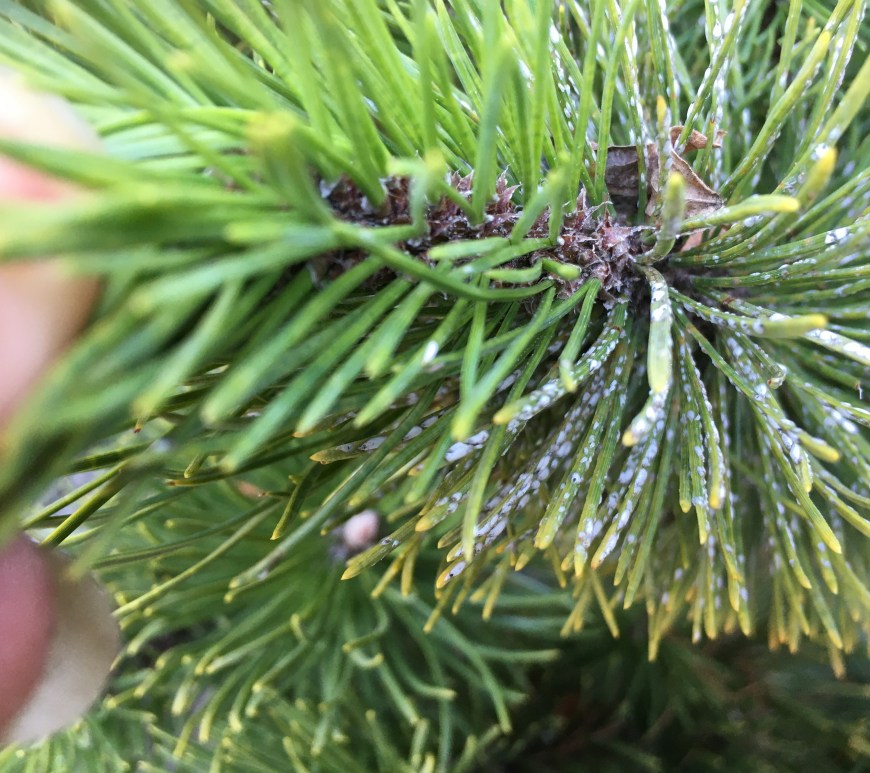
Pine needle scale (Chionaspis pinifoliae) are very small, white, stationary insects found on the needles of pine (primarily ponderosa, Mugo and scotch), spruce and occasionally, balsam fir, hemlock, and yew. They feed by inserting their stylet into the needles and sucking the juices out. This causes spotting to the branches. Badly infested trees may have a greyish appearance with needle loss. Left uncontrolled whole branches … Continue reading Pine Needle Scale: Identification, Life Cycle and Control

Poisonous to Touch Weed Series: Poison Oak (Toxicodendron diversilobum) and (Toxicodendron pubescens)

Pacific Poison Oak (Toxicodendron diversilobum) and Atlantic Poison Oak (Toxicodendron Toxicodendron pubescens) are the only two poisonous to touch plants in this series that do not grow in Canada except for the very south/western tip of British Columbia. They are not nearly as prevalent as poison ivy with Pacific poison oak occurring natively along the pacific coast of the U.S. and Atlantic poison oak occurring … Continue reading Poisonous to Touch Weed Series: Poison Oak (Toxicodendron diversilobum) and (Toxicodendron pubescens)

Poisonous to Touch Weed Series: Poison Sumac (Toxicodendron vernix)

Poison Sumac (Toxicodendron vernix) is a perennial shrub or small tree, native to eastern Canada as well as east-central and eastern United States. Like poison ivy and poison oak the leaves and berries of this plant contain urushiol (an oily mixture of organic chemical compounds); but the oil is said to be more concentrated in poison sumac. The Urushiol can cause a severe allergic reaction in sensitive … Continue reading Poisonous to Touch Weed Series: Poison Sumac (Toxicodendron vernix)

Poisonous to Touch Weed Series: Wild Parsnip (Pastinaca sativa)

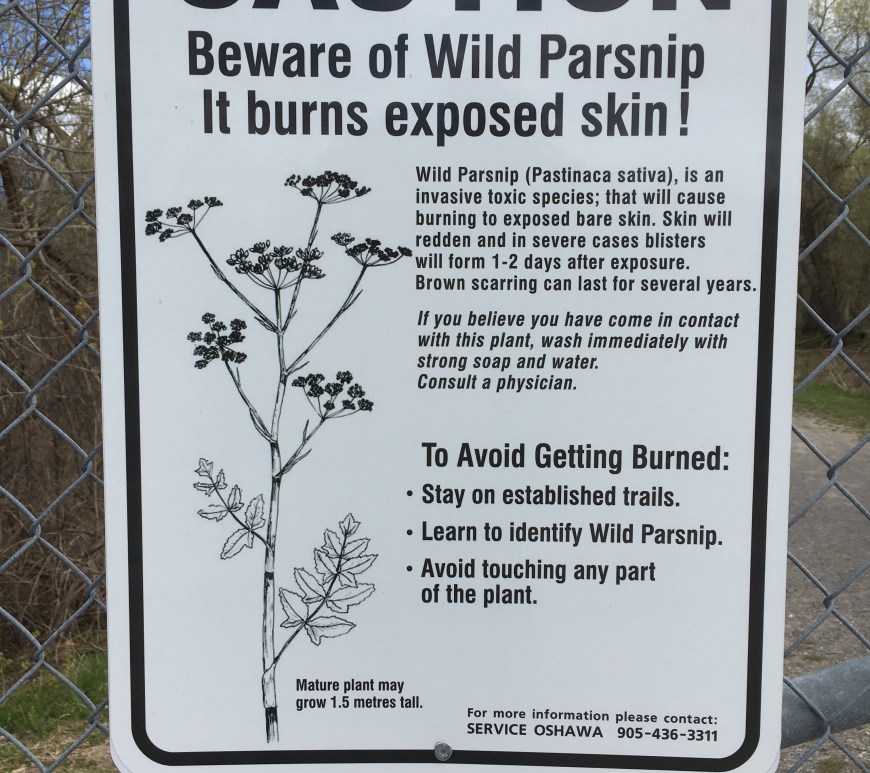
Wild parsnip (Pastinaca sativa) aka poisonous parsnip is one of the phototoxic weeds we grow here in Canada. It is a non-native and as such is an aggressive and invasive species. It is the only one of the phototoxic weeds that has a yellow flower, the others bearing white umbels. It’s pinnately compound leaves are also quite different than the palmately compound leaves of cow … Continue reading Poisonous to Touch Weed Series: Wild Parsnip (Pastinaca sativa)

Poisonous to Touch Weed Series: Cow Parsnip (Heracleum maximum)

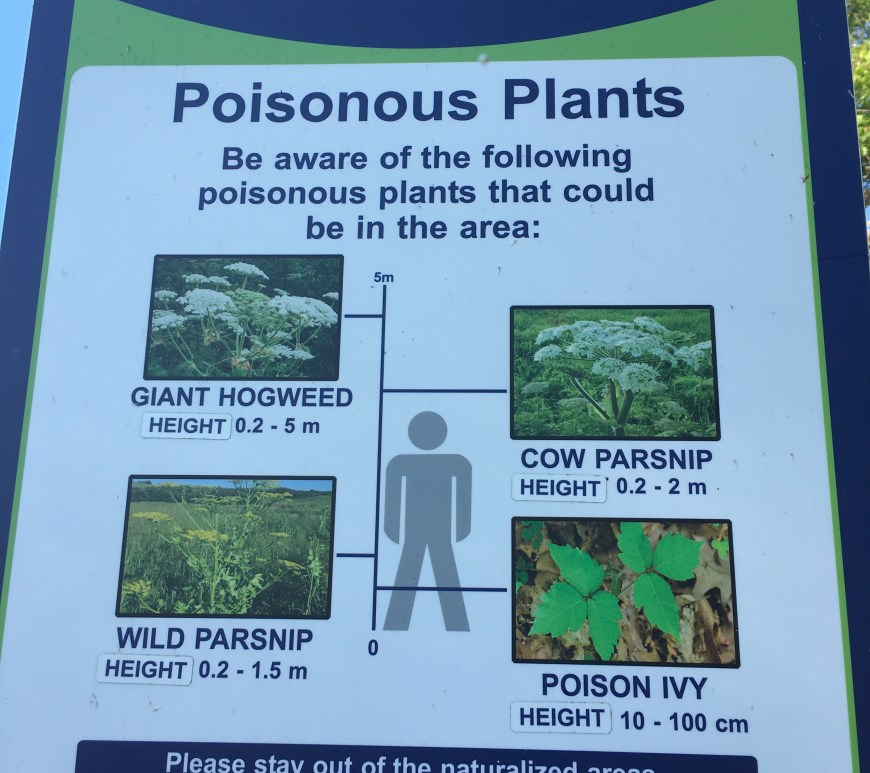
Cow Parsnip (Heracleum maximum) aka Common Parsnip or American Parsnip, is a native plant that widely grows in north America. It is a large plant rising up to heights of 1-2.5 m (3-8 ft.) when in flower. Like giant hogweed, cow parsnip contains organic chemicals within it’s sap called furanocoumarins. This chemical is activated by ultraviolet radiation and the result is severe burning, blistering and … Continue reading Poisonous to Touch Weed Series: Cow Parsnip (Heracleum maximum)

Poisonous to Touch Weed Series: Giant Hogweed (Heracleum mantegazzianum)

Giant hogweed (Heracleum mantegazzianum) is likely the largest and most dangerous to touch perennial weed in North America. In Ontario it commonly reaches heights of 3-4.5m but in other parts of the world it can reach heights of 5.5m (MacDonald F. and Anderson H. 2012). There are a few other Giant Hogweed species that are a bit smaller in size but Heracleum mantegazzianum is the … Continue reading Poisonous to Touch Weed Series: Giant Hogweed (Heracleum mantegazzianum)

Poisonous to Touch Weed Series: Poison Ivy (Toxicodendron radicans and Toxicodendron Rydbergii)

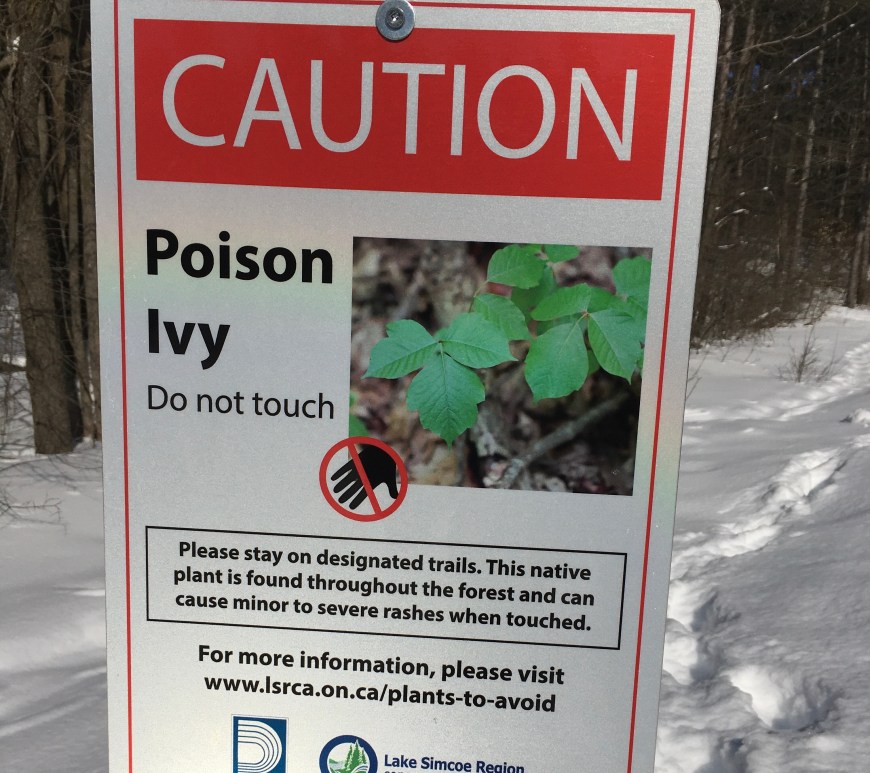
By: Kimberley Pacholko Eastern Poison Ivy, (Toxicodendron radicans) and Western Poison Ivy (Toxicodendron Rydbergii ) are important plants to learn how to identify for personal safety. Touching any part of this plant can cause a painful itchy rash with red swollen skin and painful blisters. I have had the miss fortune of being caught twice by this plant and can testify to how unpleasant the … Continue reading Poisonous to Touch Weed Series: Poison Ivy (Toxicodendron radicans and Toxicodendron Rydbergii)

Haskap Berries

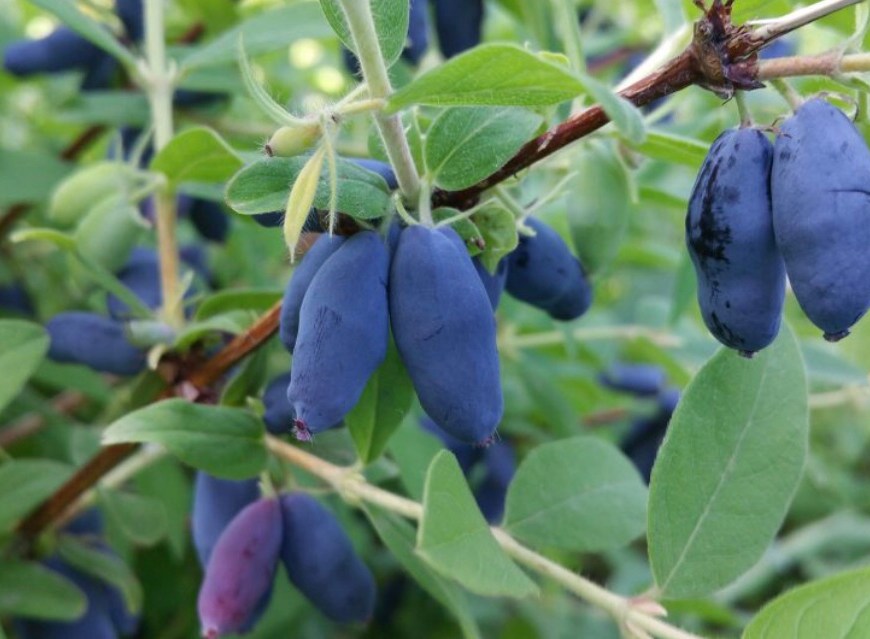
An Exciting New Crop for North America ‘Haskap’ berries (Lonicera caerulea) also known as ‘Blue Honeysuckle’, and ‘Honeyberries’ are a fast growing, cold hardy, high yielding and early harvesting berry touted to be high in vitamin C, potassium and antioxidants in addition to being high in fibre (Haskap Canada Association, n.d). Their taste (while variable depending on the cultivar) is described as being a cross … Continue reading Haskap Berries

Viburnum Leaf Beetle

Viburnum leaf beetles (Pyrrhalta viburni), are a serious threat to many species of viburnum. They are voracious feeders with a long feeding season. Both the larvae and adults feed on viburnum leaves. The larvae skeletonize the leaves while the adults chew oblong holes in them. If their numbers are great enough, they can completely defoliate a viburnum shrub, causing dieback that can lead eventually to … Continue reading Viburnum Leaf Beetle

MULCH so Many Benefits and so Many Choices

Why Mulch?    When to Mulch?   The best time to mulch is after you have finished planting in May. By this time your soil should be sufficiently warmed. Mulching to early, before your soil temperature has a chance to warm, will slow down root and plant growth. Major soil disturbances after mulching may require additional mulch. Landscape Cloth Landscape fabric is a specially designed, permeable fabric, … Continue reading MULCH so Many Benefits and so Many Choices

Fire Blight in the Ornamental Home Garden

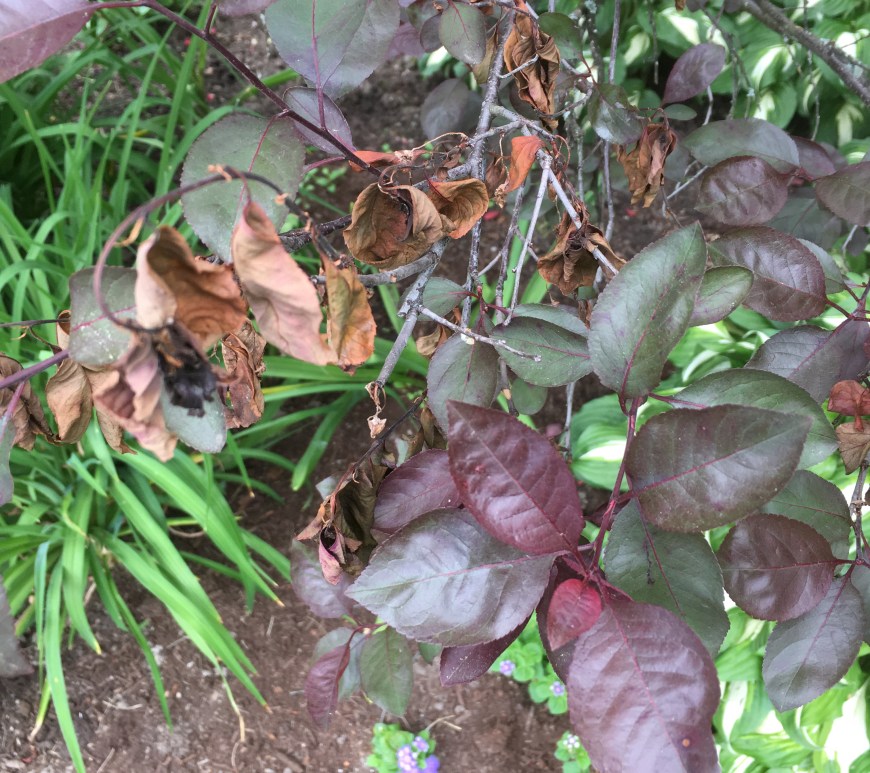
Fire Blight caused by Erwinia amylovora, is a serious bacterial disease that affects many members of the rose family (Rosaceae), such as purple sand cherry, apple, crabapple, quince, pear, plum, mountain ash and more. The trees and shrubs that have been infected have the appearance of having been scorched by fire. The disease is systemic and spreads rapidly leading to extensive damage, even death. There is … Continue reading Fire Blight in the Ornamental Home Garden

Flea Beetle Damage to Tomato Plants

If the leaves of your tomato plants appear as though they have been used as target practice at a rifle range, then chances are you have flea beetles. They are a common pest of tomato seedlings. Other plants that can be damaged include peppers, melons, potatoes, corn, spinach, eggplants, radishes and members of the brassica family (like cabbage, cauliflower, broccoli and brussel sprouts). Flea beetles can be hard … Continue reading Flea Beetle Damage to Tomato Plants

Black Knot Disease of Plum and Cherry Trees

Black Knot Disease otherwise known as Dibotryon morbosum, is a serious, yet fairly common fungal disease of plums and cherry trees (including choke cherries). Other members of the Prunus family (like peaches, nectarines, apricots and almonds) can also be affected but it is less common. The affected trees develop hard, black elongated swellings, called knots, thus the name black knot. These knots are scattered throughout … Continue reading Black Knot Disease of Plum and Cherry Trees

Natural Insect Control In The Garden

The majority of insects you find in your garden are actually harmless and require no intervention. They are either nature’s helpers or food sources for nature’s helpers. For those insects that do pose a threat to some of your plants there are several non-invasive solutions you can utilize to prevent, monitor and control these pest insects. This approach to pest management is called IPM or … Continue reading Natural Insect Control In The Garden